
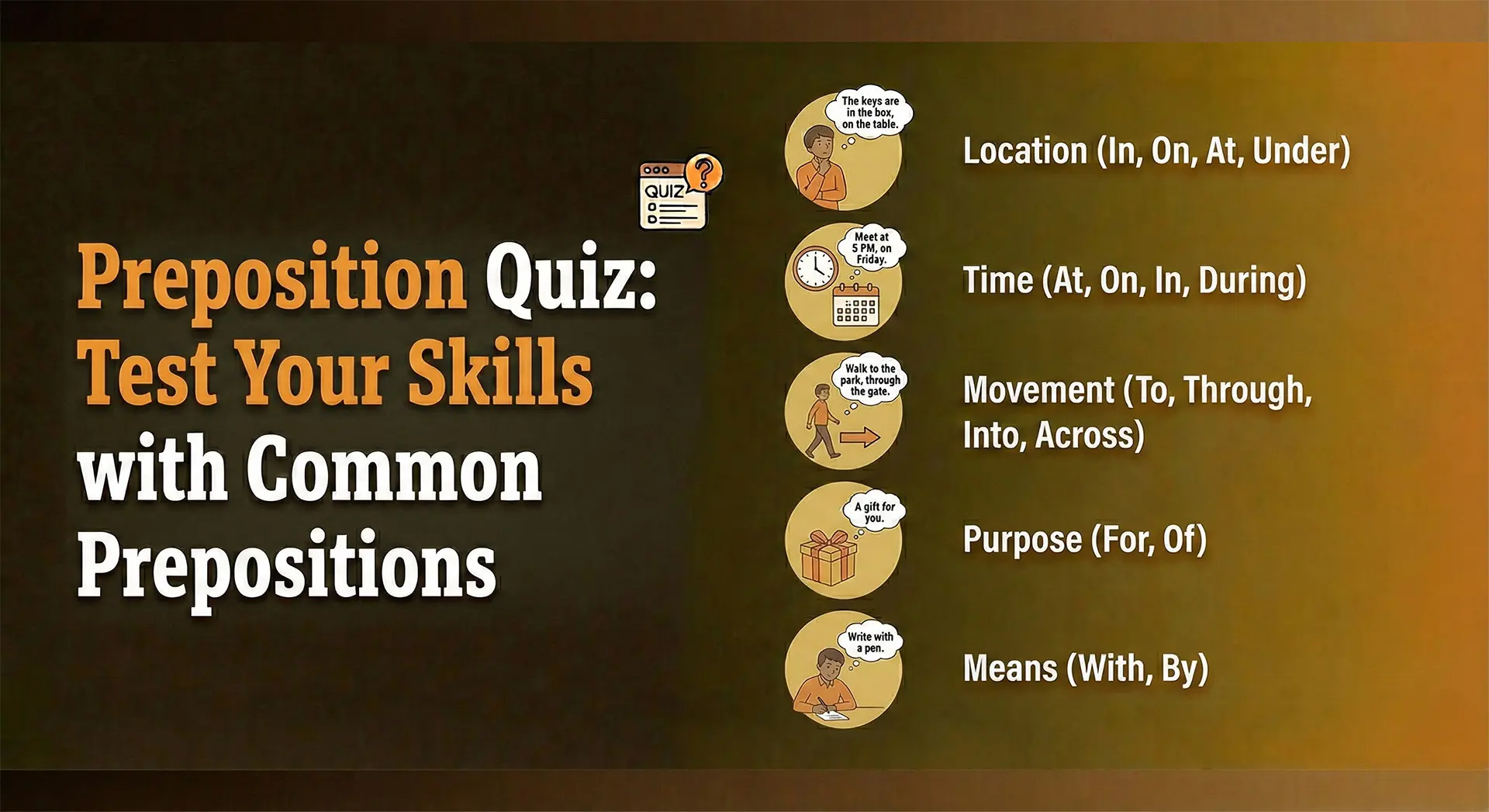
Struggling with prepositions in English? You’re not alone! Many learners find it tricky to choose between in, on, at, for, and other common preposition errors. One small mistake can change the entire meaning of your sentence. That’s why we’ve created this common preposition errors quiz to help you master these tricky grammar rules. This quiz features 10 real-world questions that test your knowledge of the most frequently confused prepositions. Each question comes with detailed explanations, examples, and practical tips so you don’t just find the right answer—you understand why it’s correct. Ready to boost your grammar confidence? Let’s dive in and see how well you know your prepositions!
📚 Complete Preposition Mastery Guide
Learn the Most Common Preposition Errors & How to Fix Them
Interested IN (Not 'at' or 'on')
When expressing curiosity or enthusiasm about something, always pair 'interested' with the preposition 'in'.
Formula: interested + in + noun/gerund (-ing form)
✓ She's interested in learning Spanish VS
✓ They’re interested in modern art
✗ I'm interested at photography.
Think of diving 'IN' to a topic you love. Also use 'good AT' for skills.
ON for Days & Dates
Use 'on' for specific days of the week, dates, or parts of specific days. Use 'in' for months/years and 'at' for specific times.
Time Prepositions: ON (days/dates) | IN (months/years) | AT (specific times)
✓ We meet on Monday morning VS
✓ The party is on December 25th
✓ She exercises on weekends
✗ See you in Friday.
ON the day, IN the month, AT the time (on Tuesday, in July, at noon).
UNDER for Position Below
Choose 'under' for something directly beneath and covered. Use 'below' for a lower level without necessarily being covered.
Position Guide: UNDER (covered/hidden) | BELOW (lower level) | BENEATH (formal/poetic)
✓ The cat is hiding under the table
✓ The apartment below mine(not directly under)
✓ Keep your bag under your seat
✗ The keys are below the pillow (incorrect)
If it's directly underneath and hidden, use 'under'. If it's just lower and visible, use 'below'.
Apologize FOR Something
When expressing regret about an action or situation, pair “apologize” with “for” to indicate what caused the apology. However, combine “apologize” with “to” when mentioning the person who receives the apology.
📑 Pattern: Apologize FOR (the mistake) + Apologize TO (the person)
✓ He apologized for the delay
✓ She apologized to her boss for being late.
✓ I apologize for any inconvenience
✗ They apologized about the mistake (incorrect)
FOR points to the REASON, while TO points to the PERSON.
AT for Specific Locations
Use 'at' for a specific point or precise location (corners, addresses). Use 'in' for larger areas or enclosed spaces.
📝Location Guide: AT (specific point) | IN (enclosed space) | ON (surface/street)
✓ The school is located at the corner
✓ Meet me at the entrance
✓ She’s waiting at the bus stop
✗ The store is on the corner (incorrect).
Think of 'at' as a pin on a map marking an exact spot. Use 'on' for streets/surfaces.
Responsible FOR Tasks
Pair 'responsible' with 'for' for duties/tasks. Use 'responsible to' for the authority you are accountable to.
📝Dual Pattern: Responsible FOR (duties/tasks) | Responsible TO (people/authority)
✓ She is responsible for managing the team
✓ The manager is responsible to the director.
✗ I’m responsible of this project (incorrect)
FOR describes WHAT you do, while TO describes WHO you report to.
Arrive AT vs. Arrive IN
Use 'at' for specific buildings or venues. Use 'in' for cities, countries, or large geographical areas.
📝 Arrival Pattern: Arrive AT (buildings/places) | Arrive IN (cities/countries)
✓ They arrived at the airport
✓ We arrived in Tokyo yesterday.
✓ She arrived at the meeting on time
✗ He arrived to the station (incorrect)
Small/Specific = AT | Large/Area = IN. Never use 'arrive to'.
Afraid OF Something
Always pair 'afraid' with 'of' to connect the fear to its object. Same applies to scared, frightened, and terrified.
📝 Fear Expressions: afraid/scared/frightened/terrified + OF + noun/gerund
✓ He's afraid of spiders
✓ She’s scared of flying
✗ I'm afraid from dogs (incorrect).
All fear-related adjectives (scared, terrified) use 'of' consistently in English.
Written BY (Passive Voice)
In passive voice constructions, “by” introduces the agent who performed the action. Furthermore, this preposition becomes essential for showing who did something when the object becomes the sentence subject.
📝 Passive Structure: Object + was/were + past participle + BY + agent
✓ The book was written by a famous author
✓ The painting was created by Picasso.
✗ Mozart composed the song from (incorrect)
Notice how “An author wrote the book” (active) transforms into “The book was written by an author” (passive). Additionally, “by” always introduces the person performing the action.
Looking Forward TO
This is a fixed expression. 'To' acts as a preposition here, so follow it with a noun or an -ing form (gerund).
📝 Structure: look forward TO + noun/gerund (NOT infinitive)
✓ We're looking forward to seeing you
✓ She looks forward to her vacation
✗ I'm looking forward to see you.
Because “to” acts as a preposition here, you must use the -ing form after it. Consequently, say “looking forward to meeting” instead of “looking forward to meet” for grammatical accuracy.
🎯 Master These Common Preposition Errors
Understanding prepositions proves crucial for fluent English communication. Throughout this common preposition errors quiz, you've explored the ten most frequently confused preposition patterns. Moreover, each question includes detailed explanations to reinforce your learning and boost retention.
📖 Practice Tips for Success:
- Read actively: Pay attention to prepositions in books, articles, and everyday conversations to build pattern recognition.
- Create examples: Write your own sentences using each preposition pattern to strengthen memory through active practice.
- Review regularly: Revisit this guide weekly to reinforce your knowledge and maintain grammatical accuracy over time.
- Apply immediately: Integrate these patterns into your daily writing and speaking to develop natural usage habits.
- Test yourself: Retake the quiz after studying to measure improvement and identify areas needing more focus.
⚡ Continue Learning
Grammar Quizzes