
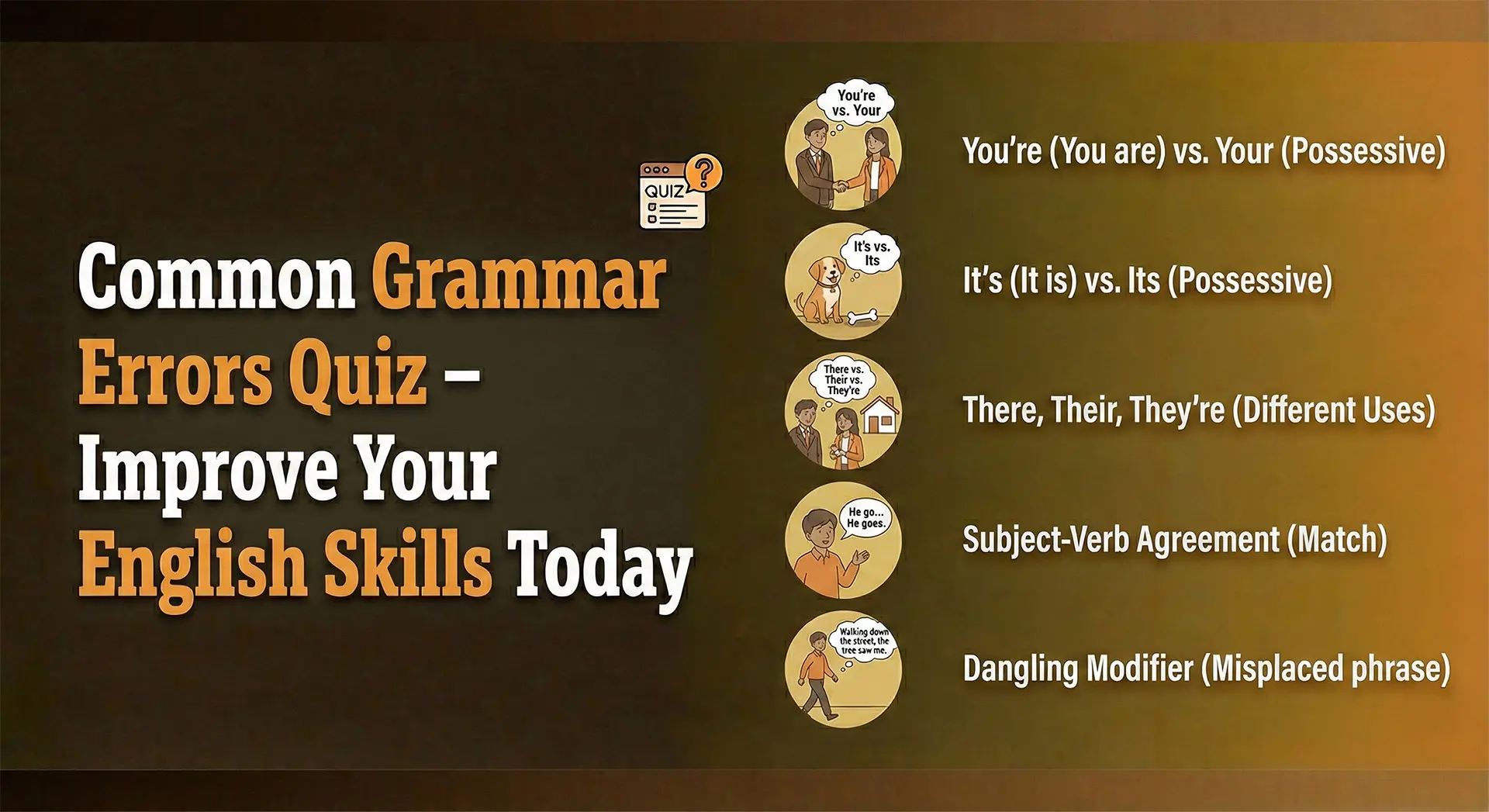
Are you confident about your grammar, or do phrases like “a few” versus “a little” still trip you up? Common grammar errors can sneak into even the most careful writer’s work, undermining credibility and clarity.
In this interactive quiz, you’ll tackle 10 of the most frequent grammar pitfalls that English speakers encounter daily. From subject-verb agreement to tricky prepositions, each question is designed to sharpen your understanding and boost your confidence.
Why does mastering these errors matter? Clear grammar enhances communication, builds professionalism, and ensures your message is understood exactly as intended. Once you know the rules, you’ll spot these mistakes everywhere—and avoid them effortlessly.
Ready to test your skills? Take the quiz below, then dive into our detailed study guide to cement your learning and become a grammar pro!
📚 Complete Study Guide
Master These 10 Common Grammar Errors
Countable vs Uncountable Nouns
Use 'a few' with countable nouns (friends, cars) and 'a little' with uncountable nouns (water, sugar).
✓ A few friends (countable) VS ✓ A little water (uncountable)
If you can put a number in front of it (1 friend, 2 friends), use “a few” or “many.” If you can’t (you don’t say “1 water, 2 waters”), use “a little” or “much.”
Subject-Verb Agreement with 'Neither'
'Neither' is always singular, even when followed by a plural noun. It means 'not one or the other'.
✓ Neither of the answers is correct
✗ Neither of the answers are correct
Words like “neither,” “either,” “each,” and “every” are always singular. Think of them as emphasizing individual items, not groups.
Relative Pronouns: Who, Whose, Whom
Who is for the subject doing the action, Whose is for possession, and Whom is for the object receiving the action.
The woman whose car was stolen (her car)
The man who called me (he called)
The person whom I met (I met him)
If you can replace the word with 'his/her,' hamesha 'whose' use karein.
Question Tags
If the statement is negative, the tag is positive. If the statement is positive, the tag is negative. They balance each other!
• You are coming, aren’t you?
• She can’t swim, can she?
• They will help, won’t they?
— think of it like a scale that needs to stay level.
Where, When, Which
Where refers to places, When refers to time, and Which refers to things or objects.
✓ The restaurant where we ate (location)
✓ The day when we met (time)
✓ The book which I bought (thing)
You can often replace “where” with “in which” or “at which” (the place in which we met).
Reported Speech: If vs That
Use 'if' or 'whether' for reporting yes/no questions. Use 'that' for reporting statements.
Direct: “Do you need help?”
Reported: She asked if I needed help.
Direct: “What is your name?”
Reported: He asked what my name was.
For information questions (What, Why), use the specific wh-word instead of 'if'.
Subject-Verb Agreement with 'Each'
'Each' is always singular because it focuses on individual members of a group separately.
✓ Each of the players is ready
✗ Each of the players are ready
✓ Each book is different
✓ Every student has a laptop
Think of 'each' as 'every single one'—it makes it easier to remember it's singular.
Than vs Then
'Than' is used exclusively for comparisons, while 'Then' indicates time, sequence, or a result.
✓ She's taller than me (comparison)
✓ We ate, then left (time).
“Than” has an “a” like “compArison.” “Then” has an “e” like “whEn” (time).
Since vs For
'Since' indicates a specific starting point in time. 'For' measures the duration or length of time.
✓ I’ve lived here Monday (point in time)
✓ I’ve lived here for three days (duration)
✓ She’s been working 9 AM
✓ She’s been working for 6 hours
If you can answer 'How long?', use 'for.' If you answer 'When did it start?', use 'since'.
Little vs A Little
'A little' means some (positive), while 'Little' means almost none (negative). Used with uncountable nouns.
There's a little hope (some) vs There's little hope (almost none).
Adding just one letter “a” completely changes the meaning from negative to positive!
🎯 Final Practice Tip
The best way to master these grammar rules is to use them in your daily writing. Start noticing these patterns in books, articles, and conversations. Soon, correct grammar will become automatic!
📚 Want to dive deeper into English mastery?
✨ Essential Start Kit – Perfect for building strong grammar foundations
🚀 Advanced Vocabulary Kit – Take your English to the next level
⚡ Continue Learning
Grammar Quizzes