
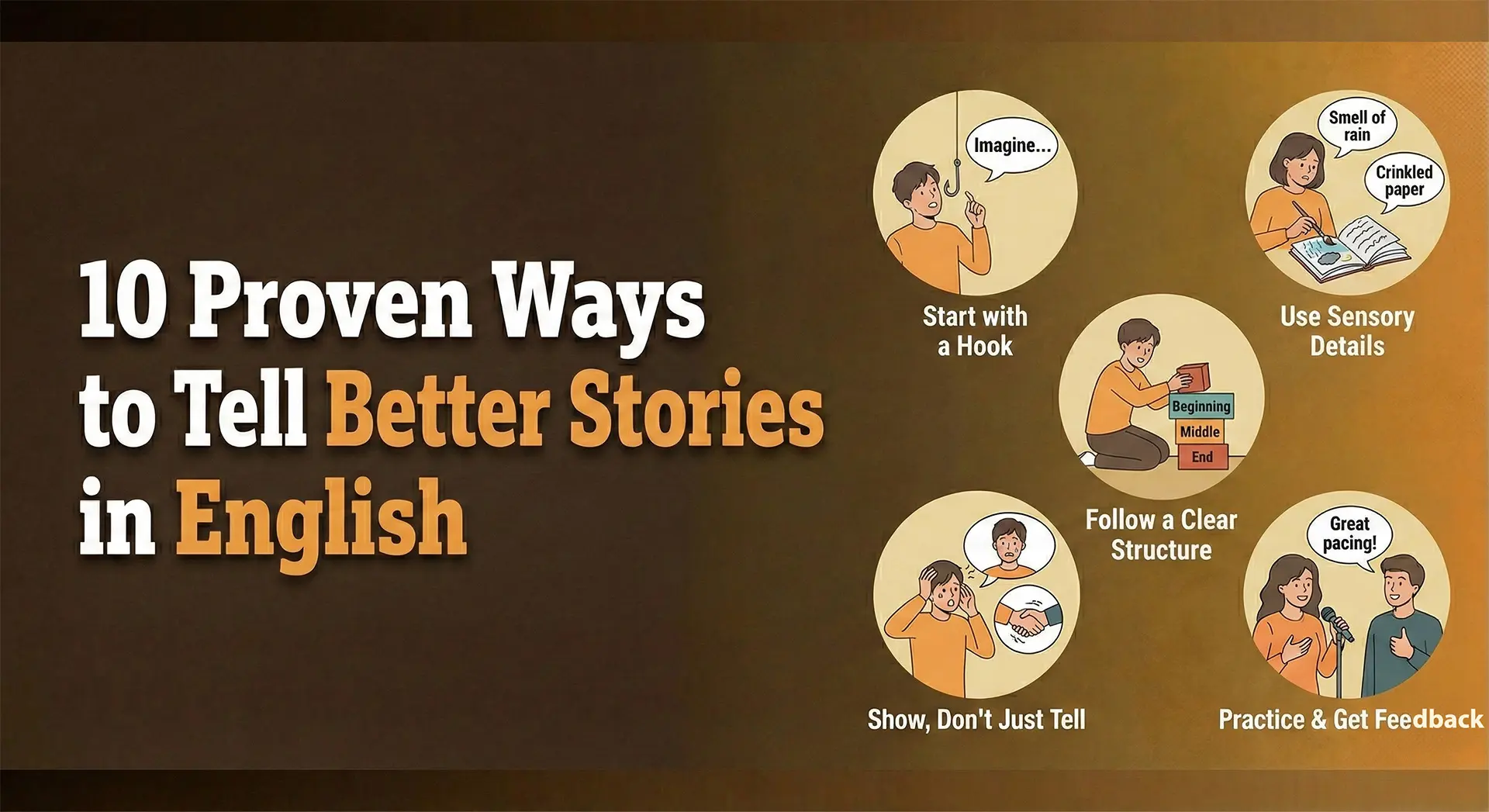
Storytelling is more than just talking—it’s how we connect, persuade, and leave lasting impressions. But here’s the truth: most English learners struggle to make their stories sound natural. Maybe you know the words, but something feels off. The good news? You don’t need perfect grammar to tell a great story. You just need the right techniques.
Why Storytelling in English Changes Everything
Have you ever struggled to make your stories sound natural in English?
Maybe you’ve got a great story in your head, but when you try to tell it, the words just don’t come out right. Or perhaps your English feels stiff and boring, even though you know the grammar rules. I get it. I’ve seen thousands of English learners face this exact problem.
Here’s the thing: learning how to tell stories in English isn’t just about entertainment. It’s one of the fastest ways to improve your fluency, expand your vocabulary, and connect with people emotionally. When you tell a story well, you’re not just speaking—you’re engaging, persuading, and creating memories.
By the end of this blog, you’ll discover 10 easy storytelling techniques for English learners that will help you sound more like a native speaker. Whether you’re chatting with friends, giving a presentation, or writing an essay, these narrative techniques will transform the way you use English.
Let’s dive in.
What Actually Makes a Good Story in English?
Before we jump into the techniques, you need to understand what makes a story work in English. It’s not about using fancy words or perfect grammar. Instead, it’s about structure, emotion, and clarity.
Every good story has five basic elements:
| Story Element | Example |
|---|---|
| Setting | “It was a rainy evening in London…” |
| Characters | “My best friend Sarah and I decided to explore the city.” |
| Conflict | “But suddenly, the lights went out.” |
| Climax | “We heard footsteps getting closer and closer.” |
| Resolution | “Turns out, it was just the security guard doing his rounds!” |
These elements give your story a beginning, middle, and end. Without them, your listener gets confused or loses interest. Learning how to structure a story in English is essential for clear communication.

In English-speaking cultures, stories often include humor or self-deprecation. That means poking fun at yourself or adding a funny twist. It makes you more relatable and keeps people listening. Also, English speakers love stories that show emotion rather than just state facts. Instead of saying “I was happy,” they might say “I couldn’t stop smiling for hours.” This technique—called “show, don’t tell”—makes your story come alive.
Ready to learn the techniques? Let’s go.
10 Narrative Techniques in English for Confident Storytelling
1. Use the Past Tense Naturally
When you’re telling a story in English, you’ll mostly use past tenses. However, native speakers don’t just stick to simple past. They mix simple past, past continuous, and past perfect to add depth and flow.
Think of it this way: simple past describes what happened (“I walked home”). Past continuous sets the scene or shows background action (“I was walking home”). Past perfect shows something that happened before the main events (“I had already walked three blocks before I noticed”).
Example: “I was walking home when I saw a shooting star. It was beautiful. I had never seen one before.”
Using these tenses together makes your story sound natural and gives it rhythm. English speakers often mix tenses for storytelling flow, not strict grammar. Don’t worry about being “perfect”—focus on sounding natural.
Mini Action: Think about what you did last weekend. Write three sentences using different past tenses to describe it.
Want to master this? Check out my guide on how to use tenses when telling stories in English—covering when to switch between past simple, continuous, and perfect for maximum impact.
2. Add Time Connectors
Time connectors are words that help your story flow smoothly from one event to the next. They create a sense of pacing and suspense.
| Phrase | Meaning | Example |
|---|---|---|
| Then | Next in sequence | “I finished breakfast, then I left for work.” |
| Suddenly | Without warning | “Suddenly, the door slammed shut.” |
| Later | After some time | “Later that evening, I got a strange call.” |
| Eventually | In the end | “Eventually, we found our way back home.” |
| In the end | Final result | “In the end, everything worked out fine.” |
| Meanwhile | At the same time | “Meanwhile, my friend was stuck in traffic.” |
English stories love suspense pacing. Words like “suddenly” or “just then” build anticipation and keep people hooked. These transitions create rhythm and drama in your narrative.
Mini Action: Take a short story you’ve told before. Rewrite it using at least three time connectors.
3. Show, Don’t Tell
This is one of the most powerful storytelling techniques for English learners. Instead of telling your listener how you felt, show them through actions, descriptions, or dialogue.
Compare these examples:
- Telling: “I was scared.”
- Showing: “My hands were shaking, and I could barely breathe.”
The second version creates a vivid picture in the listener’s mind. They can imagine exactly what you’re experiencing.
Example: Instead of “The restaurant was crowded,” say “People were squeezed into every corner, and the noise was deafening.”
Western storytelling values imagery over emotion labels. The more visual your story, the more engaging it becomes. This is what separates good storytellers from great ones.
Mini Action: Think of two sentences where you “tell” an emotion. Now rewrite them to “show” instead.
4. Use Dialogue for Realism
Adding dialogue to your story makes it feel real and alive. Even a short line of conversation can change everything. Instead of summarizing what someone said, let them speak directly in your story.
Example: Instead of “She disagreed with me,” try “She looked at me and said, ‘You’re kidding, right?'”
See the difference? Dialogue breaks up long descriptions and gives each character a voice. It also helps you practice natural English phrases. In English-speaking cultures, dialogue keeps stories lively—even in small talk! People use it constantly to make conversations more engaging.
Mini Action: Add one line of dialogue to a story you’re working on. Notice how it changes the tone.
Need more help? Check out my guide on useful phrases for starting, continuing, and ending a story in English—you'll get ready-to-use expressions that make dialogue natural and effortless.
5. Vary Your Sentence Length
Long sentences are great for detail. Short sentences create impact. Mixing both keeps your story interesting.
Look at this example: “I had been planning this trip for months. I booked flights, researched hotels, and read every travel blog I could find. Then the day came. I was ready.”
See how the short sentence “Then the day came” adds drama? That’s the power of variety. Native speakers use pauses and short lines for dramatic effect. It’s not about grammar—it’s about emotion and pacing.
Mini Action: Rewrite a paragraph using one short sentence and one long sentence alternately. Feel the rhythm change.
6. Add Emotion Words & Tone
English has so many words to describe feelings. Instead of always saying “happy” or “sad,” try words like thrilled, relieved, annoyed, amazed, frustrated, or nervous.
| Basic Word | More Expressive Word | Example Sentence |
|---|---|---|
| Happy | Thrilled, delighted, overjoyed | “I was thrilled when I got the job offer.” |
| Sad | Devastated, heartbroken, miserable | “She was devastated when she heard the news.” |
| Angry | Furious, livid, outraged | “He was furious after waiting for two hours.” |
| Scared | Terrified, petrified, alarmed | “I was terrified when I heard the noise.” |
| Surprised | Shocked, stunned, amazed | “I was amazed by the beautiful sunset.” |
These words make your story more colorful and help your listener feel what you felt. English storytelling focuses on tone as much as vocabulary. The way you say something matters just as much as what you say.
Mini Action: Look at your last story. Add three feeling words that make it more emotional.
Want to go deeper? I've got a detailed guide on how to add emotion and tone to your English stories—it'll show you exactly how to sound natural, expressive, and engaging.
7. Use Idioms and Phrasal Verbs
Native speakers love idioms and phrasal verbs. They make your English sound less textbook and more authentic. Instead of “I started my journey,” say “I hit the road.” Instead of “I arrived late,” say “I showed up late.”
| Idiom/Phrasal Verb | Meaning | Example in Story |
|---|---|---|
| Hit the road | Start a journey | “We hit the road at 6 a.m. and drove for hours.” |
| Break the ice | Start a conversation | “She told a joke to break the ice at the meeting.” |
| Call it a day | Stop working | “We were exhausted, so we called it a day.” |
| Run into | Meet by chance | “I ran into my old teacher at the supermarket.” |
| Figure out | Understand/solve | “It took me hours to figure out what went wrong.” |
These small changes make a huge difference in how natural you sound. British and American idioms differ—pick your style! For example, Americans might say “hang out,” while Brits say “meet up.”
Mini Action: Replace three simple verbs in your story with idiomatic phrases.
Curious about more? I have shared a fun guide on 10 English idioms for storytelling that you can use in everyday conversations. Also, test your knowledge with this British vs American English quiz or try the 41 British phrases quiz.
8. Create Suspense
Suspense keeps people listening. It makes them wonder, “What happens next?” You can build tension using simple phrases that hint at something unexpected coming.
Example phrases:
- “Little did I know…”
- “Suddenly…”
- “Out of nowhere…”
- “Just when I thought it was over…”
Example: “I thought I was alone. Little did I know, someone had been watching me the whole time.”
Cliffhangers are common in English stories. Whether it’s a joke, a memory, or a serious event, English speakers love leaving their audience hanging for a moment before revealing the ending.
Mini Action: Add one suspenseful moment to your short story. See how it changes the mood.
9. Add a Personal Touch
Your stories should feel like yours. Include your feelings, thoughts, or reflections. This makes your story unique and memorable. Instead of just describing what happened, share what you learned or how it changed you.
Example: “That day taught me not to judge people too quickly. Sometimes, first impressions are completely wrong.”
Another example: “Looking back, I realize that moment changed everything. It made me braver.”
Self-reflection is key in Western storytelling culture. People appreciate honesty and vulnerability. It shows you’re real, not just reciting facts. Personal stories create deeper connections with your audience.
Mini Action: Add one personal takeaway to the end of your story.
10. End with a Moral or Twist
A great ending leaves a lasting impression. You can either wrap up with a lesson (a moral) or surprise your listener with a twist.
Moral Example: “And that’s when I realized that sometimes, the best adventures are the ones you don’t plan.”
Twist Example: “I reached into my bag, pulled out the wallet, and froze. It was mine all along!”
Both types of endings make your story memorable. English stories often end with irony or humor. It’s a way to keep things light, even if the story had serious moments. This applies to English story writing for beginners and advanced speakers alike.
Mini Action: Rewrite your story’s ending with a surprise twist or a meaningful lesson.
Want to add humor? I'm working on a guide about how to tell funny stories in English without losing the joke—perfect for making people laugh while improving your fluency.
Putting It All Together
Let’s see these techniques in action. Here are some English story examples for practice. I’ll show you a simple story told two ways.
Before (without techniques):
“I went to the park. I saw a dog. The dog was cute. I played with the dog. Then I went home.”
After (with narrative techniques in English):
“Last Saturday, I decided to take a walk in the park. The weather was perfect. As I was strolling near the pond, I suddenly noticed a golden retriever running toward me. He was adorable—tongue out, tail wagging like crazy. I knelt down, and he jumped right into my arms. We played fetch for about twenty minutes. Eventually, his owner called him back, and I headed home with a huge smile on my face. That day reminded me how little things can bring so much joy.”
See the difference? The second version uses past tenses, time connectors, emotion words, and a personal reflection. It feels alive. That’s how you improve English storytelling skills.
Your Turn: Record yourself telling a short story using at least five of these techniques. You can even share it with a friend or post it online. Practice storytelling in English regularly, and you’ll see fast results.
Common Mistakes to Avoid When You Tell Stories in English
Even with all these narrative techniques for ESL students, learners often make a few common mistakes. Here’s what to avoid:
Using Only Simple Past Everywhere
If every sentence is “I did this, then I did that,” your story sounds flat. Mix in past continuous and past perfect for depth. Varying your tenses makes your storytelling sound more natural.
Over-Explaining Instead of Showing
Don’t tell your listener every detail. Trust them to imagine. Instead of “I felt really, really scared and nervous,” just say “My heart was pounding.” Show the emotion through action.
Forgetting Transitions
Without words like “then,” “suddenly,” or “later,” your story feels choppy and hard to follow. Always use connectors to guide your listener smoothly through the events.
Speaking in Long, Complex Sentences
Keep it simple. Long, complicated sentences confuse your listener. Break them up into shorter, clearer thoughts. Remember: clarity beats complexity.
Not Adding Emotion
Facts alone don’t make a good story. Add how you felt, what you thought, and why it mattered. Emotion is what makes people care about your story.
Want to avoid more pitfalls? Explore my full guide on common storytelling mistakes in English and how to fix them—so you can catch errors before they become habits.
How to Practice Storytelling in English
Want to get better? Here are a few simple exercises to try:
Daily Story Challenge: Every day, tell someone (or write down) a short story about your day using at least three techniques from this blog.
Rewrite a Fairy Tale: Take a famous story like Cinderella and retell it in your own words using idioms, dialogue, and emotion.
Record Yourself: Use your phone to record a 2-minute story. Listen back and notice where you can improve.
Join a Storytelling Group: Find online communities where English learners practice storytelling together.
These exercises will help you learn English through stories faster than any textbook. The more you practice, the more confident you’ll become.
Looking for more practice? Check out my full resource on storytelling exercises for English learners—it'll include worksheets, prompts, and activities you can do solo or with a partner.
Wrap-Up: Start Telling Better Stories Today
Let’s recap. To improve how to tell stories in English, remember these 10 techniques:
- Use past tenses naturally to add flow
- Add time connectors for smooth transitions
- Show, don’t tell to create vivid imagery
- Use dialogue to make your story feel real
- Vary sentence length for rhythm and drama
- Add emotion words to express yourself clearly
- Use idioms and phrasal verbs to sound more natural
- Create suspense to keep listeners hooked
- Add a personal touch to make it your own
- End with a moral or twist to leave an impression
These techniques work whether you’re learning English through stories, preparing for an exam, or just trying to sound more confident in conversations. They’re the foundation of English speaking fluency through storytelling.
Now it’s your turn. Try using at least three of these storytelling techniques in your next English conversation. Better yet, write a short story in the comments below using the methods you just learned. I’d love to read it!
Want more tips? Join our community on Telegram or Instagram where we share daily English tips, quizzes, and challenges. And don’t forget to check out these helpful resources:
- British Phrases Quiz – Test your knowledge of British slang and expressions
- 75 English Phrases for Daily Life – Speak like a native every day
Remember, storytelling isn’t just a skill—it’s a superpower. Master it, and you’ll not only improve your English, but you’ll also connect with people in ways you never thought possible.
Now go tell your story. The world is waiting to hear it.
Frequently Asked Questions ?
Storytelling in English learning means using narratives to practice speaking, writing, and understanding the language. It helps learners improve fluency, vocabulary, and confidence by sharing personal experiences or fictional tales.
To tell a good story in conversation, start with a clear setting, use past tenses naturally, add dialogue and emotion, and end with a twist or moral. Keep it short, engaging, and relatable. Practice makes you better over time.
Narrative techniques in storytelling include using descriptive language, varying sentence length, adding dialogue, creating suspense, showing instead of telling, and using time connectors. These techniques make your story more engaging and natural.
Common English phrases for storytelling include "Once upon a time," "Suddenly," "Little did I know," "In the end," "Out of nowhere," and "That's when I realized." These phrases help structure your story and keep listeners interested.
Practice storytelling by recording yourself, retelling famous stories in your own words, joining English conversation groups, and using storytelling prompts. Start small with short stories and gradually add more techniques as you improve.
⚡ Continue Learning
Speak English- English Pronunciation Practice: 5 Habits That Work
- How to Think in English: 7 Powerful Strategies for Natural Fluency
- 3 Essential Tenses for Storytelling in English (2025 Guide)
- 25 Essential English Words You Need Before Your Next Trip Abroad
- 12 Rules for a Perfect English Introduction: Formal to Casual
